“A Legal Assembly” and the Burning of the Bank of America
Performance art forged in resistance leads to the experimental audio compositions of Professor Edward Loomis and our final examination of his work, “Advice to the Lovelorn”

“A Legal Assembly” and the Burning of the Bank of America · Aggrovox
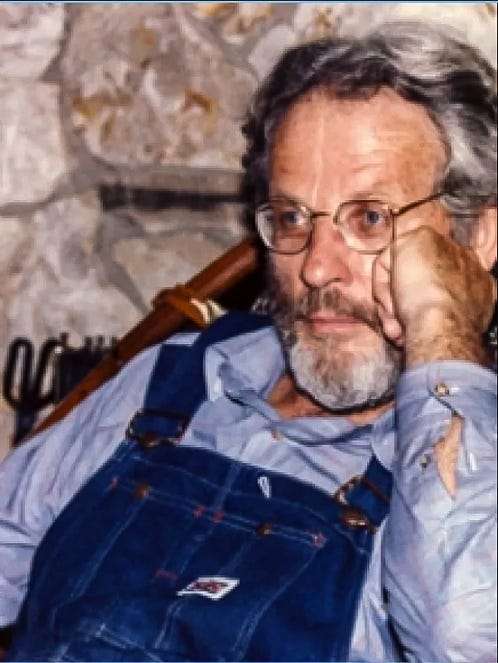
Press play on AggrovoxThe original post on Substack, with the full audio playerEd, Chairman of the Department of English at UCSB in 1968 pictured after his retirement from teaching in 1987 at his home in Goleta, California – Santa Barbara Independent
Before listening to “Advice to the Lovelorn” it helps to understand where Ed’s experimentation with audio composition began.
Against the backdrop of the national campus protests of 1969, and as the new decade dawns the professor in UCSB’s English department (1) crafts a unique response to the government-imposed state of siege gripping the campus and the nearby student enclave of Isla Vista (IV). The government’s violent response to campus unrest, and to protest in the one square mile beachfront student community adjoining the campus inspires Ed and his collaborators to create a performance art experience, “A Legal Assembly.” The single performance at UCSB’s Campbell Hall provides the community’s answer to the police and campus administrators who have declared that all assemblies are illegal.
Events overtake UCSB and IV that catapult the students, faculty, and the larger community into national attention. On Wednesday, February 25, 1970, protestors torch the Bank of America and Governor Ronald Reagan takes little convincing to send 600 National Guardsmen to patrol the streets with fixed bayonets. The juxtaposition is striking; students hustle to class wearing flip flops riding skateboards and bikes while National guardsmen, many the same age as the students stand guard over the bank.
John Filo (left) with a camera in hand, overlooking the National Guardsmen and students on May 4, 1970. Photograph by James Coon, Kent State Shootings Photographs from Various Sources.
Less than ten weeks after the National Guard is stationed in IV, students Allison Krause, Jeffrey Miller, Sandra Scheuer, and William Knox Schroeder at Kent State University in Ohio will be shot dead by National Guard troops.
National Guard troops stationed at the top of the Embarcadero loop in Isla Vista, February 1970 - Joe Melchione, El Gaucho Newspaper
Ed’s lifelong collaborator Frank Goad reports in his recollections of the night at Campbell Hall on the UCSB campus that Rolling Stone magazine gave the only performance of A Legal Assembly a “rave review.”
The show starts with Dick Johnston’s Shakespearean-style narrator addressing the audience while standing in a pool of blinding white light dressed only in a surgical gown. When he finishes introducing the players, Noggin (Ed Loomis), Crayon (Frank Goad), and Dry Paint (Dick Johnston) he turns to leave the stage and provides the audience with a full view of his bare ass.
Contemporary accounts note that Ed reads from his own prose with a semi-metronomic baritone voice, keeping ‘logic-time’ for the piece that connects the disparate elements. Frank Goad later writes that the Rolling Stone review described the performance as a ‘light show’, ‘concert’, and ‘a reading’. There is little doubt that the event presented spectacle, in the finest tradition of the form.
The night in Campbell Hall is nothing less than the Big Bang Moment for the audio explorations that Ed will continue with his collaborators and by himself for the next thirty years.
After the Big Bang
Advice to the Lovelorn may be Ed’s most ‘mainstream’ audio composition – the most album-like. In the piece, “What is Literature?” (reviewed Here) Ed takes the audience on an audio and musical journey through myth and religion to discover the roots of inspiration and creativity. It’s an intellectual exercise in observation; finding order in both the syllogistic and the qualitative moments of the creative process. (2)
Advice to the Lovelorn feels unique among Ed’s experimental audio compositions – it may be more personal, like theory put into practice, and it demonstrates that he’s interested in much more than an intellectual deconstruction of literature, or creativity, or even ethnic mythology. It’s Ed the novelist, grappling with a new set of narrative tools and devices and using them to make us feel, to teach us, and perhaps help us to improve the human condition.
“If you’re not part of the solution, you’re part of the problem” was Ed’s oft repeated admonition to students, which traces directly to the “Stanford Formalism” he studied as a PhD student in the 1950’s. Advice to the Lovelorn sees the emotional narrative taking the wheel. It may be that Ed intends the work to continue his investigation into the tension between the formalism of his mentor at Stanford, Ivor Winters, contrasted with the emotion-driven narratives saturating contemporary electronic media (radio, TV, films, etc.). I listen to the work like the “A” side of an LP; it’s a series of 6 ‘tracks’, each about as long as a typical song on the radio. Each track is a discrete song, but when experienced together the effect is more like an 18 minute ‘rock opera’.
Advice to the Lovelorn includes found sounds, voice characters, musical instruments, and electronic synthesizer sounds that repeat musical themes and it ends with a sort of natural sound coda that returns the listener to a world filled with the order of nature, and delight.
The work’s verdict on love? Maybe that love is inescapable. Maybe that the pursuit of love begins at many different places for different reasons in the human heart, it progresses, and then sometimes cools or ends. Maybe that love is completely unpredictable and will always make a mockery of structure and formalism.
NOTES
(1) Ed’s chairmanship is a turning point for the department; in 1968 he invites Kenneth Rexroth, ‘Father of the Beats’ to join the English deptartment faculty and the move is reportedly met with “rage and shame” by some in the academic community. Rexroth famously taught a course called “Poetry and Song” and the Montecito Journal reported the class was colloquially referred to as “Rexroth’s Nightclub” where students would perform skits or play instruments and Rexroth would lecture on everything from jazz to Gnosticism. Rexroth lived the last 14 years of his life in Montecito. A more “Qualitative” worldview than Rexroth’s would be hard to find. https://www.montecitojournal.net/2023/05/16/kenneth-rexroth-a-poet-of-montecito/
(2) Follow the link to hear Ed’s work, “The Lear Project” and read about the tension between the syllogism of the school of Stanford Formalism espoused by Ed’s academic mentor, Yvor Winters, and the modern qualitative expression style of media entering the culture in the 60’s and 70’s that challenged it. https://aggrovox.substack.com/p/the-lear-project
Get Aggrovox by email
Live tapes, unreleased concerts and the stories behind them. Free, in your inbox.
Free on Substack · Aggrovox