Fats Domino, Live & Unreleased: The Hits – Press Play Before Reading
A stereo sound board recording of Domino’s final festival performance at the Grande Parade du Jazz for 1980

Fats Domino, Live & Unreleased: The Hits – Press Play Before Reading · Aggrovox
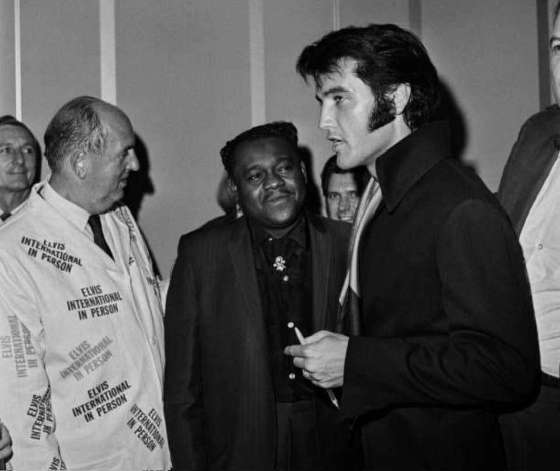
Press play on AggrovoxThe original post on Substack, with the full audio playerElvis Presley called Fats Domino ‘the real king’ of Rock & Roll during a famous press conference held immediately after the 1969 opening night of Elvis’ run of fifty-seven sold-out shows at the Las Vegas International Hotel (later the Hilton). Domino looks a little amused in the publicity shots, and contemporary reports suggest he’s not calling himself the king of anything.
What Domino witnesses between 1950 and 1960 is a widening gap between the two artist’s impact in the marketplace. At the start of the decade Elvis and Fats are the closest rivals in records sold, but by the Vegas residency Elvis popularity rockets past Domino’s. In his lifetime Fats is credited with 65 to 110 million sales, while Presley’s estate now estimates over a billion including reissues. Interestingly, both are inducted during the Rock and Roll Hall of Fame’s first ceremony.
Antoine “Fats” Domino Jr. is born on a Sunday, February 26, 1928, in New Orleans to a violinist father who speaks Creole as a first language. In their Lower Ninth Ward home Fats learns piano from his uncle Harrison Verrett. In 1947 Billy Diamond, a local bandleader of some notoriety hires Fats into the Solid Senders band at the Hideaway Club at $3 per week - good money for 18- or 19-year-old Antoine. It’s Diamond who names him “Fats” after Fats Waller and Fats Pichon.
In 1949 Imperial Records signs Domino and he meets his longtime producing partner, Dave Bartholomew. Between his first record for Imperial and signing with ABC-Paramount in 1963 the two men create dozens of hits, including many in the article’s playlist. Domino’s band leader on the tape introduces him as the owner of ‘twent-three Gold records!’ Domino would eventually collect a total of 35 gold records.
The Origins
Dave Bartholomew builds the sound and the band that churns out virtually all of Fats Domino’s hits. Many of their combined writing credits feature in tonight’s performance. Bartholomew, born in 1918 – a decade before Fats - learns from the best. First the tuba and trumpet from Peter Davis who also teaches Louis Armstrong, and then on the job training arranging in Papa Celestin’s and Fats Pichon’s bands, later leading Pichon’s band. In 1949 Bartholomew meets Lew Chudd, founder and owner of Imperial Records, and becomes Imperial’s first A&R man in New Orleans.
During a tumultuous first year at Imperial Bartholomew writes and produces the irrepressible hits, “I Hear You Knocking” and “Lawdy Miss Clawdy” with Domino on piano. Bartholomew produces nearly every Domino hits in the fifties, recording at Cosimo Matassa’s J&M Studio, using minimal gear, almost no separation between instruments (discernable on careful listening to the originals), and an intimate room sound that bigger studios can’t match.
Two sax players in Bartholomew’s band are session regulars at J&M studios: Lee Allen, and Herbert Hardesty. They are both heard on tonight’s recording, and both are on nearly every Domino hit. Allen says that on 100% of the dozens of Domino top ten hits during the fifties, the arrangements were worked out live in the studio and that no sheet arrangements exist. Both Hardesty and Allen are the legends out front in the concert tape. Legends still teaching after more than 100 years.
The Band
The tour’s manager, who may be Quint Davis – it’s his card that’s found tucked into the tape cassette case - introduces the band on the stage twice; eight players not including Fats.
• Herbert Hardesty, tenor sax and trumpet. He plays on Domino’s records from “The Fat Man” (1949) onward; by his own estimate Hardesty plays 90% of the sax solos until 1963, including “I’m Walkin’” and “Blue Monday” (on “Blue Monday” he plays a baritone sax at Fats’ request). In 1980 he rejoins the band after a hiatus in Las Vegas, which means Nice is one of his first tours back.
• Lee Allen, tenor sax. He plays most of the sax solos on Little Richard’s hits in 1955-56, including Tutti Frutti. He arrives at New Orleans jazz by way of an athletic and academic scholarship to Xavier University. In 1980 he’s back from retirement and touring again with Domino before becoming a mentor, and member of The Blasters.
• Joseph “Smokey” Johnson Jr., drums. Grows up in the Tremé neighborhood in New Orleans and he enters the picture when he joins Bartholomew’s band. He’s a fixture with Domino, touring the globe full-time 1973–93. He’s the drummer chasing the sliding kit and glowering at the frantic assistant stage manager in the first article about the show [see link below].
• Frederick Kemp, tenor sax. He is running the show, standing just behind and to stage right of Fats. He’s Domino’s trusted bandleader, and it’s his voice on the tape urging the crowd to ‘give it up for the one and only Fats Antoine Domino!’ Kemp holds down the touring band for Domino for 13 years – a polished outfit that never misses a cue in every recording found during research for this article.
• Thomas Johnson, trumpet. Johnson holds the trumpet first chair through Domino’s later touring years. He’s on the famous Montreux recordings, and he’s still with the band when Fats retires in 1993. , Montreux again in 1983, and still on stage there in 1993.
• Carlton McWilliams, bass. McWilliams anchored the Fats Domino Orchestra for decades. Contemporary accounts place him with Domino’s band in 1980 and 1983, and he appears in the lineup at Los Angeles’ Universal Amphitheatre in 1985.
• Teddy Royal, lead guitar. Royal starts his career playing New Orleans funk sessions for Quezergue and Toussaint. He joins Domino in 1977, first on bass, and stays with the band on and off for 25 years.
• David Douglas, “the other” lead guitar. Douglas is the band’s veteran guitarist. He backs Domino at Montreux in 1973, released as Live at Montreux, and was still with the band in 1983.
The Songs
1. I’m Walkin’
• Credit: Fats Domino and Dave Bartholomew.
• Record: Imperial 5428, released February 23, 1957. #1 R&B for six weeks, #4 pop. The B-side was “I’m in the Mood for Love,” which is also in the Nice set.
• Recorded at J&M the session band is the studio’s core players. The studios name likely stems from J&M Amusements Service, a jukebox and record company owned by the studio owner Cosimo Matasas’ father and another partner. Hardesty plays the sax solo, with Lee Allen also on sax, Frank Fields on bass, Earl Palmer on drums and Papoose Nelson on guitar. Ricky Nelson’s cover the same year also reached #4 pop.
• At Nice: Hardesty and Allen are both on stage, so two of the record’s horn players are playing their own parts 23 years on. Hardesty likely takes the solo.
2. Blue Monday
• Credit: Dave Bartholomew (Domino often shares the credit on reissues).
• Record: Smiley Lewis recorded and released it first. Domino’s version is Imperial 5417, late 1956; #1 R&B, #5 pop.
• On the record Hardesty plays the solo on baritone sax, picking up the instrument on the spot because Fats asked for it.
• On the recording solos trade between baritone and tenor – likely Hardesty, Kemp, and maybe as Allen well.
• Blue Monday is part of the PBS documentary, “Fats Domino: Walkin’ Back to New Orleans.” Fats’ performance of Blue Monday in 2007 at Tipitina’s, a comeback of sorts staged in his honor, is his last performance of substance. Accounts suggest Fats wasn’t planning to play but was convinced while backstage to attempt Blue Monday, which turned into another twenty minutes of material.
3. I’m in Love Again
• Credit: Fats Domino and Dave Bartholomew.
• Record: Imperial, March 1956, B-side is the pop standard “My Blue Heaven,” and the record is a hit on both sides. #1 R&B for seven weeks (his fifth R&B #1), #3 pop.
• The record took him into the pop top five, months before “Blueberry Hill.”
• At Nice: Slightly up-tempo compared to the ’56 recording and done live there’s more room to find significant solos Hardesty, et all.
4. I’m Ready
• Credit: Fats Domino, Al Lewis and Sylvester Bradford. No Bartholomew credit.
• Record: Imperial 5585, May 1959; #16 pop, #7 R&B.
• Story: Al Lewis is the Tin Pan Alley lyricist who co-wrote “Blueberry Hill” in 1940, so the same writer turns up twice in this set.
• At Nice: A less produced and maybe more satisfying slice of roots rock and roll than the sub-two-minute version on the record. Still lightning speed in the set, but it doesn’t get any more original.
5. I Want to Walk You Home
• Credit: Fats Domino alone.
• Record: Imperial, July 1959, backed with “I’m Gonna Be a Wheel Someday” (also in the Nice festival set). #8 Hot 100; #1 R&B for one week.
• The song was Domino’s last R&B #1, played 17 years after it charted.
• At Nice: The song resonated with the crowd, with couples slowly dancing in front of the stage. The song’s punchline at the end delivered with perfect timing as the band launches into Blueberry Hill.
6. Blueberry Hill (150 words, the centerpiece)
• Credit: Vincent Rose, Larry Stock and Al Lewis, 1940.
• Before Fats: Sammy Kaye recorded it first; Glenn Miller’s version reached #2 in 1940.
• The doubt: Bartholomew told Lew Chudd not to release it, calling it a nothing song; it shipped three million units. The Library of Congress registry says Domino insisted on recording it over his producer’s doubts.
• Record: Imperial 5407, 1956. #1 R&B, #2 pop, stuck behind Elvis’ “Love Me Tender” and then Guy Ritchie’s cover of Marty Robbins’ “Singing the Blues.” It doesn’t chart on the Hot 100 because it doesn’t start until 1958.
• Legacy: Added to the National Recording Registry.
• At Nice: The unmistakable ‘Fats Domino triplets’ start the song; the edit is inelegant but unfortunately necessary.
7. Jambalaya (On the Bayou)
• Credit: Hank Williams (a Moon Mullican, ‘King of the Hillbilly Piano Players’ co-credit is disputed).
• Record: Hank Williams original, 1952. Domino’s version is Imperial X5796, 1961, #30 pop. The other side was “I Hear You Knocking,” Bartholomew recorded the song first for Smiley Lewis.
• Story: A New Orleans R&B singer turns a country hit about Louisiana back into Louisiana music.
• At Nice: About 20 seconds are missing at the tape change; they run out at the worst possible times without fail.
8. When the Saints Go Marching In
• Credit: Traditional, arranged by Bartholomew and Domino.
• Record: Imperial, 1959. Verify the catalog number and whether it was a B-side.
• Story: His walk-off for at least twenty years, always rolling into “Sentimental Journey.” That’s documented from 1973 to 1993.
• At Nice: The last song of the set proper, and a real jam at the end. The Stagger Lee / Josephine medley recording and description may be found in the first article (link below).
The End
The first Fats Domino article on Aggrovox includes the exuberant two-song Stagger Lee / Josephine encore, and Quint Davis’ crowd work on the mic to end the show (if that is indeed his voice as the Master of Ceremonies). A weary-sounding Davis announces the 6 a.m. departure of the band for Germany the next morning. Documented dates in Eutin, Germany follow starting July 23, and research uncovers database listings for a July 20 performance at Montreux (contradicting my recollection of the date I made the recording). I wonder if Quint Davis could settle the debate?
It’s likely just past midnight with the last notes hanging in the air as the staff hustles to get on the crew bus for the short trip to the waterfront and the Hotel Mercure – the festival’s offices. Over the next several hours the hotel bar is transformed into a giant jam session as players sit in, change seats (and sometimes instruments), and make wonderful noise until nearly dawn.
Epilogue
*I can’t verify my tape’s date. It could be the 21st, or the 22nd. I found strong documentation for a “Montreux” concert in Switzerland on the 20th. I know that what I recounted in my prior article about Domino’s appearance happened on July 20, (he likely played three or more shows across ten days). Did he play after the 20th? I was only working one of the three stages. It’s unlikely I somehow recorded an earlier show and NOT the show wrote about. It’s possible. Being a great contemporary chronicler is clearly not my strongest attribute.
The first article
The full set
Band introductions open and close the show and are not listed.
1. I’m Walkin’: written by Fats Domino and Dave Bartholomew · Domino’s original, Imperial 5428 (1957)
2. Please Don’t Leave Me (audience request): written by Fats Domino · Domino’s original, Imperial (1953)
3. Blue Monday: written by Dave Bartholomew · Smiley Lewis original (1953/54); Domino’s version Imperial 5417 (1956), #1 R&B / #5 Pop
4. I’m Gonna Be a Wheel Someday: written by Roy Hayes, Fats Domino and Dave Bartholomew · Bobby Mitchell & the Toppers (1957); Domino’s version Imperial (1959)
5. I’m in Love Again: written by Fats Domino and Dave Bartholomew · Domino’s original, Imperial 5386 (1956)
6. I’m Ready: written by Fats Domino, Al Lewis and Sylvester Bradford · Domino’s original, Imperial 5585 (1959), #16 Pop / #7 R&B
7. I Want to Walk You Home: written by Fats Domino · Domino’s original, Imperial 5606 (1959)
8. Ain’t That Just Like a Woman: written by Claude Demetrius and Fleecie Moore · Louis Jordan & His Tympany Five (1946); Domino’s cover Imperial X5723 (1961)
9. Blueberry Hill: written by Vincent Rose, Larry Stock and Al Lewis · pop standard (1940); Domino’s cover Imperial 5407 (1956), #1 R&B / #2 Pop
10. I’m in the Mood for Love: written by Jimmy McHugh and Dorothy Fields · pop standard (1935); Domino’s cover Imperial (1957)
11. Shake, Rattle and Roll: written by Jesse Stone (as Charles Calhoun) · Big Joe Turner (1954); no Domino studio release, live only
12. Jambalaya (On the Bayou): written by Hank Williams (Moon Mullican co-credit disputed) · Hank Williams original (1952); Domino’s cover, late 1961, #30 Pop. About 20 seconds lost at the tape change.
13. So Long: written by Fats Domino · Domino’s original, Imperial 5396 (1956)
14. Let the Four Winds Blow: written by Fats Domino and Dave Bartholomew · Domino’s original, Imperial (1961)
15. When the Saints Go Marching In / Sentimental Journey (medley, closes the set): traditional, arranged by Dave Bartholomew and Fats Domino / Les Brown, Ben Homer and Bud Green (1944) · Domino’s “Saints” Imperial (1959); no Domino studio release of “Sentimental Journey”
16. Stagger Lee (encore): traditional · popularized by Lloyd Price (1958); no Domino studio release, live on Live at Montreux (1973)
17. My Girl Josephine (encore, attacca): written by Dave Bartholomew and Fats Domino · Domino’s original, Imperial X5704 (1960)
Get Aggrovox by email
Live tapes, unreleased concerts and the stories behind them. Free, in your inbox.
Free on Substack · Aggrovox