Fats Domino: Live, Rare, & Unreleased – Press Play Before Reading
In this 90-minute headlining set from the ‘80 Nice Jazz Festival Fats goes deep into his musical influences

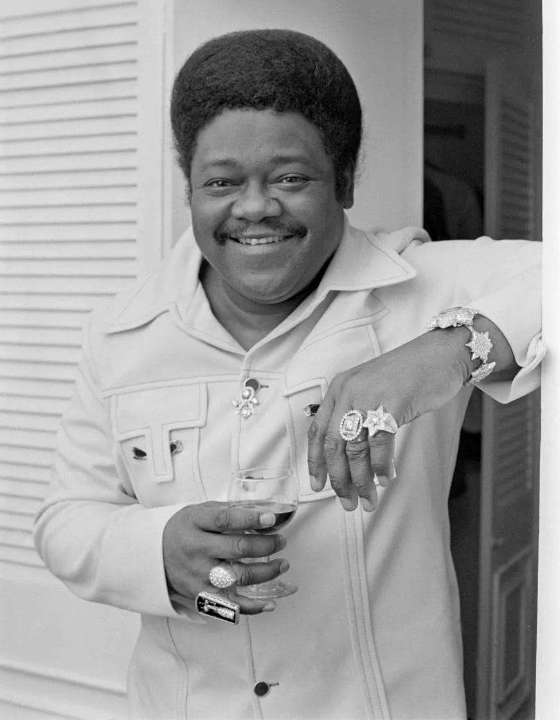
Fats Domino: Live, Rare, & Unreleased – Press Play Before Reading · Aggrovox
Press play on AggrovoxThe original post on Substack, with the full audio playerWord reaches the crew late into the 20-minute stage changeover: Fats is under the weather tonight, it’s his last performance of the festival, and he’s an important headliner on this next to the last night of the ten-day festival. Because I am the assistant, the stage manager tells me to hustle to the green room to find out what’s going on. It’s clear when I arrive that Fats can’t make the walk – it’s at least a quarter mile across the former Roman ruins. It falls to me to walk his limo along the winding walking paths to the backstage.
I leave behind two crew members to finish setting up during the 20-minute stage changeover from the prior act, a job I would normally supervise. Like a walking flagman from the earliest days of the automobile, I shoo spectators out of the way as politely as possible while the closed Rolls Royce limo follows silently behind me at walking pace.
Fats as a headliner draws a big crowd tonight and as I approach backstage, I see the festival brass assembled: George Wein and his right-hand lieutenant John Schreiber are both watching, along with several dignitaries, artists, and Festival Productions, Inc. senior staff. I duck into the sound truck and start the tape.
Traditional blues and R&B performances start with the band warming up the crowd, and then an audio flourish announces the star taking the stage. The Fats Domino Band starts the warmup number and immediately I spot a problem. Nobody has bothered to secure the drums to the stage. The kit needs a few nails to keep it from sliding across the plywood stage. Without nails in front of the high-hat and the kick drum the whole kit is marching in slightly different directions an inch or two on every measure. The drummer is dragging his throne with one hand, and gesticulating to the wings, moving the high-hat, and all while keeping time on the snare. Not ideal, and he looks pissed.
There’s apparently no stopping the show, so I grab a hammer and nails and crawl ass-and-elbows commando style onto the stage in the middle of the number. I’m under the drummer’s right knee, nails between my teeth and wedged against the kick so I can drive in a nail. I’m trying to do it in time to the beat. The drummer looms above me and he’s still not happy. I manage to stop the kit’s forward progress a few feet from the piano. My cheeks are burning as I receive both approving (‘you saved it, kid’), and disapproving comments (‘why wasn’t that kit nailed down?!’) when I exit the stage.
The Artist
None of the behind-the-scenes stage drama makes it onto the tape. The only evidence might be at the end of the warm-up number when Fats asks several times for more piano volume in his stage monitor. The request may come because the drums are drowning out the piano in the mix - they are effectively now right next to his piano bench.
During the 1980 festival Fats is decades removed from his first #1 R&B hit, “Goin’ Home.” Most fans remember his second #1, “Ain’t That a Shame” from 1955 (he didn’t play it, or somehow I didn’t record it that night). The song also reaches #10 on Billboard’s pop chart, and it’s his first effort that earns him substantial white radio station rotation.
During the Rock & Roll Hall of Fame induction ceremony in 1986 - the very first - Billy Joel salutes Fats with a simple statement: “The man who proved that the piano was a rock and roll instrument.” He is inducted alongside Elvis Presley, Jerry Lee Lewis, James Brown, Ray Charles, Sam Cook, The Everley Brothers, Little Richard, and Buddy Holly.
Fats charts 37 Top 40 singles, and sells 65 million records (a conservative estimate) which places him in rare solo artist company like Neil Diamond, Prince, Paul McCartney, and Bob Marley.
At Elvis Presley’s Las Vegas residency at the Hilton hotel in 1969, Fats is in attendance during a press conference when a journalist refers to Presley as “The King of Rock & Roll.” Elvis points at Fats standing in the room and says, “That’s the real king of rock and roll.” In multiple subsequent interviews Elvis acknowledges that Fats was “a huge influence on me when I started.”
After Fats Domino’s 2017 death Rolling Stone Australia’s obituary quotes him from a 1957 interview when he seemingly soft-sells his historic contribution, “Everybody started callin’ my music rock and roll, but it wasn’t anything but the same rhythm and blues I’d been playin’ down in New Orleans.”
The Rock Hall’s president, Greg Harris, in his statement on Fats’ passing puts the induction-night accolades for Domino in even plainer terms: “Before Elvis, Jerry Lee, and Chuck Berry there was Fats.”
The Songs
Please Don’t Leave Me — Domino wrote it himself, recorded it in April 1953, and it charted #3 R&B for 14 weeks — a genuine early hit, not an obscurity. But it’s pre-crossover: two years before “Ain’t That a Shame” got him onto pop radio, this was strictly an R&B-market hit, never touching the Hot 100. He’s not reviving a deep cut here; he’s reaching back to the version of stardom he had before white America noticed.
Ain’t That Just Like a Woman — Written by Claude Demetrius and Fleecie Moore, not Domino, and a #1 R&B hit for Louis Jordan back in 1946, when Fats was still a teenager. His own 1961 version (Imperial 5723, off the album I Miss You So) only reached #33 pop — a minor hit at best. He’s covering the generation of R&B that raised him, on a song whose guitar intro Chuck Berry would later borrow wholesale for “Johnny B. Goode.”
I’m in the Mood for Love — A 1935 McHugh/Fields pop standard, decades outside Fats’ usual frame of reference, he cut it in January 1957 purely as the B-side to “I’m Walkin’” — it never charted on its own merits, riding entirely on the A-side’s success. There’s no evidence it was ever a “hit”; he’s playing it live to give the audience a rest, and because every professional bandleader keeps handy a catalogue of crowd-pleaser standards.
Shake, Rattle and Roll — Jesse Stone’s song, a hit for Big Joe Turner in 1954 and, separately, for Bill Haley on the pop charts the same year. There is no Domino studio recording and no official live release either — I checked the Live at Montreux set list and it isn’t there. This is the one that earns the set list its ‘rarity claim: a song from his own generation’s hit parade that he apparently played live for decades and never once put on a record.
Stagger Lee — The first song of the two-song encore, it’s a traditional murder ballad tracing to an actual 1895 St. Louis shooting over a hat (Lee Shelton killing Billy Lyons), popularized as a #1 hit by Lloyd Price in 1958. Fats never released a studio version, but it does have an official live recording — also on Live at Montreux, 1973. Stagger Lee is a documented part of his live repertoire for at least seven years before Nice, not a one-off; what’s rare is that he never recorded it in a studio despite playing it live repeatedly.
My Girl Josephine — His own song, co-written with Dave Bartholomew, and a real hit: #7 R&B, #14 pop in 1960 (Imperial X5704, off ...A Lot of Dominos!). It also has an official live version on Live at Montreux — under the alternate title “Hello Josephine,” same song. Between the 1960 studio hit and the 1973 live recording, this is his most thoroughly documented song in the set; notable is its placement, snapped in right after “Stagger Lee” with no gap.
The End
The escaping drum kit isn’t the only physical danger I face during Fats’ set. During the Sentimental Journey wrap, he plays it with an emphatic ‘thigh-thump’ against the edge of the keyboard on the chorus. He’s not a big man, but he’s apparently very powerful. Nobody thought to nail the piano down, so now IT is slowly creeping toward the front of the stage. A nine-foot Bosendorfer piano costs as much as a small house in 1980 and weighs as much as a VW. With one last thump the front leg crashes off the stage, falling a few inches into a metal grating for the stage lights. It hangs there. Fats exits the stage once he realizes what’s happened and the band vamps the remainder of Sentimental Journey for his walk-off music.
It takes six of us to lift the front leg back onto the stage while the band preps for the Stagger Lee / My Girl Josephine encore. I can’t hear the piano crashing on the tape, but I’ll never forget it happening.
Epilogue
In a second article I’ll cover the crowd-pleasers Fats plays in his 90-minute set, including
I’m Walkin’
I’m Walkin’
Blue Monday
Blue Monday
I’m in Love Again
I’m in Love Again
I’m Ready
I’m Ready
I Want to Walk You Home
I Want to Walk You Home
Blueberry Hill
Blueberry Hill
Jambalaya (On the Bayou)
Jambalaya (On the Bayou)
When the Saints Go Marching In
When the Saints Go Marching In
In a weird twist of fate I face danger a third time that fateful night at the all-night jam session that starts after midnight back at the conference hotel. A series of performers take turns buying me Heinekens for my birthday. Dizzy Gillespie, not to be outdone, tells the bartender, “Give him two!” I don’t remember much about walking home that night at 5am, but I do remember waking up at noon with an epic hangover.
Full set list from my tape, Fats Domino, Grande Parade du Jazz, July 20, 1980
Band Intro
Band Intro
I’m Walkin’
I’m Walkin’
Please Don’t Leave Me
Please Don’t Leave Me
Blue Monday
Blue Monday
I’m Gonna Be a Wheel Someday
I’m Gonna Be a Wheel Someday
I’m in Love Again
I’m in Love Again
I’m Ready
I’m Ready
I Want to Walk You Home
I Want to Walk You Home
Ain’t That Just Like a Woman
Ain’t That Just Like a Woman
Blueberry Hill
Blueberry Hill
I’m in the Mood for Love
I’m in the Mood for Love
Shake, Rattle and Roll
Shake, Rattle and Roll
Jambalaya (On the Bayou) - partial
Jambalaya (On the Bayou) - partial
So Long
So Long
Let the Four Winds Blow
Let the Four Winds Blow
When the Saints Go Marching In
When the Saints Go Marching In
Sentimental Journey
Sentimental Journey
Stagger Lee (encore)
Stagger Lee (encore)
My Girl Josephine (encore, attacca off Stagger Lee)
My Girl Josephine (encore, attacca off Stagger Lee)
Finally, if you’ve read this far I have a request. If you know anything about mixing, EQ, compressors, exiters and the like, send me some tips about how to get the best out of these recordings. The processing, I’ve convinced myself brings them to life, but I have not idea what I’m doing - I’m just twisting knobs and moving faders to see what happens. Any suggestion gratefully received.
Get Aggrovox by email
Live tapes, unreleased concerts and the stories behind them. Free, in your inbox.
Free on Substack · Aggrovox