Randy Newman and His Amazing Dancing Bear: Why America's Greatest Living Songwriter Was Kicked Off the NYT List
Being an indifferent tape-labeler and archivist in my twenties meant that invariably I would ‘find’ fragments of live performances I recorded on the odd cassette here and there...

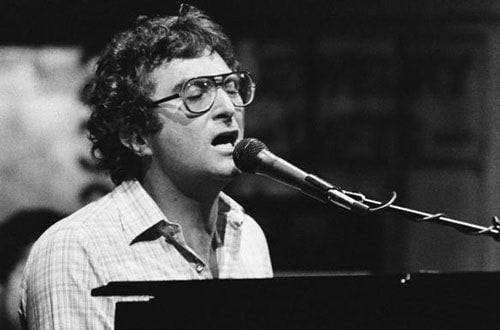
Randy Newman and His Amazing Dancing Bear: Why America's Greatest Living Songwriter Was Kicked Off the NYT List · Aggrovox
Press play on AggrovoxThe original post on Substack, with the full audio playerThe Randy Newman songs streaming here were found ‘hiding’ on a tape with a Joni Mitchell ticket stub tucked into the clear plastic face of the cassette box. The stub is for the concert filmed in 35mm for Mitchell’s epic “Shadows and Light” concert feature. I was there, but that’s not what’s on the tape. Instead, it’s a Mitchell commercial album and thirty-odd minutes of a Ravi Shankar performance I recorded at the Ojai Music Festival (I’ll digitize that concert another day).
At the end of Shankar’s recording is Newman’s encore from Campbell Hall - on Leap Day in 1980 (read more and listen to additional clips from the concert here: “Randy Newman: Chemicals, the Flood, and the Big One”). It’s a precious haul: “Rednecks” is part of the encore. It’s impossible to write about the controversy surrounding Newman’s songs, nor his omission from the NYT “30 Greatest Living Songwriters” list without talking about “Rednecks.” The first article tries, but it was written before discovery of the missing songs.
A rainy night on the UCSB campus finds Randy Newman discussing the flooding taking place at his home in Los Angeles while he entertains the campus audience
The New York Times’ critics panel polled 36 professional songwriters to create the ‘best’ list. Nine songwriters include Newman on their ballots. Bonnie Raitt and David Byrne both rank Newman #1 on their ballots. The NYT’s critics’ panel overrules the actual writers. Newman’s nine votes across all voters ties Jimmy Webb (also excluded), and beatsBilly Joel (7), Patti Smith (6), and James Taylor (6); all are excluded. Two artists who each receive just two votes are on the list.
What convinced the NYT panel to remove Newman from the list?
Will Layman gets it the most right in his article, “The ‘30 Great Living American Songwriter’ Debacle,” when he calls the NYT list “a Frankenstein thing…” He rightly suggests that the critics’ panel want a list that will cause a ruckus and collect eyeballs so they can anoint their favored hip ‘innovators’ in pop songwriting. And he reminds us that lists aren’t journalism.
Writer Will Layman’s article in Substack makes a convincing case that ‘clicks’ outweighed rational thought in the final selection of artists in NYT’s ‘best of’ list
Layman digs deeper when he responds to statements made by Joe Coscarelli, one of the NYT authors of the article. He says, “our task was to complicate what came back to us” (from the 36 writers who were polled). Layman correctly interprets this to mean the list would have been overweight, “clogged at the top with way too many rock and singer-songwriter types... most of them... white guys.” Among those that Layman names: Newman.
Critical examination of the NYT decision demands a deeper dive still. Newman isn’t just some “white guy,” he’s the most prolific writer alive examining archetypal white guys who have an (imagined) axe to grind. He uses the literary device of the unreliable narrator perhaps better than any other songwriter in history. In so doing he shines a light on the weakness, racism, and failures of his many characters – with greater clarity than anyone writing contemporary popular music today, maybe even more clearly than anyone currently writing about popular culture.
The extent to which society misunderstands and misappropriates Newman’s unreliable narrators is an indictment of society, not Newman. And it’s exactly the reason he was unceremoniously booted from the list despite the votes he received.
Missing the point of Newman’s satire is like saying George Carlin is a bigot because he mimics bigots in his act. It’s like arguing that Jonathan Swift supports Lilliputians starting bloody wars over disagreements about which end of an egg to crack open first (some critics in 1721 did…).
Simon Smith and His Amazing Dancing Bear (1972, Sail Away)
Newman reports he discovers his songwriting voice and the unreliable narrator while unsuccessfully trying to write a song for Frank Sinatra Jr. Working with what were many unfulfilling drafts of a light-hearted pop song, the rhyme “a coat to wear” and “a dancing bear” stick in his mind. He invents the character of Simon, who believes that the proper coat and a dancing bear will gain him entry to polite society. When Newman invents Simon he is quoted in interviews saying this experience is the moment his songwriting changed forever.
Newman’s incredible cast of characters draws listeners into his songs like Dickens’ characters draw in readers. At a conservative count across 20+ albums and including a musical adaptation of Faust with wholly new characters (!) Newman has so far created over 200 characters! Witnessing the birth of Newman’s unique artistic voice and then following his prolific output is a rare ‘few-in-a-lifetime’ experience for his fortunate audience.
Rednecks (1974, Good Old Boys)
In 1970 Lester Maddox is famous as the face of Southern white racism. Maddox appears on the Dick Cavett show and it’s a disaster. Fellow guests Jim Brown, the famous NFL icon, and author Truman Capote witness Maddox melt down when Cavett won’t apologize for suggesting that some of Maddox’s admirers may be bigots. It was in fact Brown who suggested white bigots in Georgia might be upset to learn ab out Maddox’s work in support of black voters in the state - after Maddox spends fully two minutes bragging. It’s comical that Maddox turns his anger on Cavett and largely ignores Brown sitting right next to him.
“Rednecks” (1974) recalls the Dick Cavett Show spectacle
Last night, I saw Lester Maddox on a TV showWith some smart-ass New York JewAnd the Jew laughed at Lester MaddoxAnd the audience laughed at Lester Maddox tooWell, he may be a fool, but he’s our fool
-Randy Newman, “Redneck”
The song’s narrator then describes going to the park “with some paper” to write the song. It’s clearly the narrator’s story, and not Newman’s.
Newman can be forgiven his literary license recasting Cavett in the song as a “New York Jew” - Cavett himself is a Protestant from the Midwest, not Jewish. Not everyone buys the defense that the song is “satire, not endorsement” and some question whether Newman gets a pass here. Newman says he has performed the song live only once in the past decade, and further says he might perform it in San Francisco, but not St. Louis, and only for an audience that “knows me well.”
The song ends with Newman’s unfiltered examination of the fundamental assumptions every audience that hears the song makes about racism, and freedom. It’s a startling narrative departure, but he does it so infrequently that it lands with thunder. At Campbell Hall nobody is unmoved by the song’s ending, and the applause builds a convincing argument that the college audience, at least, hasn’t entirely missed the point of Newman’s narrator.
Newman’s brother Alan, a physician in Los Angeles has said, “Randy hates it when people don’t realize he has created an insensitive persona on record to serve as a dramatic device,” and that the narrator in the song “is not somebody he likes.” He adds that Randy considers civil rights and racism among the country’s most important domestic issues, while also “asking for compassion for bigots” through the song.
Short People (1977, Little Criminals)
Asking audiences to stick with characters beyond the impulse to reject them is Newman’s genius. “Asking for compassion” isn’t the same as suggesting anything beyond attempting understanding. Nobody should believe Newman asks us to forgive the unforgivable; he shows us the ‘hidden’ sin, like Dorian Gray’s portrait in the locked room at the top of the stairs. In both cases audiences witness private guilt made visible.
In 1978 Newman reaches his commercial peak, charting the single, “Short People” (1977, Little Criminals) all the way to #2 on Billboard magazine’s Hot 100. No other song in his career, before or since, comes anywhere close to the success. “Short People” has another distinction, no other song stirred up as much controversy nor consequences for Newman.
Radio stations ban the song. Civic groups rally to denounce the writer, and coalitions of short people demand redress. The fact that the song is 100% satire, that it lampoons the prejudice espoused by the narrator, and that Newman intends to pillory offense has little effect on the public perception.
Newman has performed the song only once since 2016, making this never-heard version something of an archaeological find.
You Can Leave Your Hat On (1972, Sail Away)
In a 2013 Newman interview on NPR he’s asked about, “You Can Leave Your Hat On” and he describes the character as a bossy romantic partner: “he’s a pretty weak fellow.” Intending to satirize the type of toxic masculinity common today in social media apps and online comment sections, the song takes on a life of its own in 1986 with Joe Cocker’s cover version for the film, “91/2 Weeks.” Kim Basinger and Mickey Rourke’s kinky sex couple and the song become an unfortunate match made in heaven.
A lone male audience member erupts in a forceful applause when Newman comes to the line, “Now shake ‘em.” The audience doesn’t go along, and the sharp clap hangs in the air. Newman looks up from the piano briefly and when the chorus comes around, he deadpans, “I know, it’s pretty exciting.” If anyone was at all ambivalent about what Newman expects the audience to think of the song’s protagonist, there is now no doubt.
Misunderstanding, and misappropriation appear to be the fate of Newman’s ‘controversial’ songs. This same error in judgement feels like it’s at the root of his deletion from the unserious NYT list.
Epilogue
Should I have included “Sail Away” in this group? It seems that fewer people misunderstood that particular Newman song. I can’t find anyone who wrote ‘that’s pro slavery!’, but I didn’t do a deep dive. PS - it’s a haunting version. LMK if anyone wants to hear it, or any of the other songs.
Partial Set List
(I don’t think I’ve found the whole show yet - that’s how bad my labeling was)
1 They Just Got Married 1979 Born Again
2 Yellow Man 1970 12 Songs
3 Marie 1974 Good Old Boys
4 Birmingham 1974 Good Old Boys
5 You Can Leave Your Hat On 1972 Sail Away
6 Ghosts 1979 Born Again
7 Short People 1977 Little Criminals
8 Sigmund Freud’s Impersonation of Albert Einstein in America 1979 Born Again
9 Louisiana 1927 1974 Good Old Boys
10 The Girls in My Life (Part 1) 1979 Born Again
11 The Story of a Rock and Roll Band 1979 Born Again
12 Simon Smith and the Amazing Dancing Bear 1972 Sail Away
13 Sail Away 1972 Sail Away
14 God’s Song (That’s Why I Love Mankind) 1972 Sail Away
15 In Germany Before the War 1977 Little Criminals
16 Political Science 1972 Sail Away
17 A Wedding in Cherokee County 1974 Good Old Boys
18 Linda 1968 Randy Newman
19 Rider in the Rain 1977 Little Criminals
20 Guilty 1974 Good Old Boys
21 Rednecks 1974 Good Old Boys
Get Aggrovox by email
Live tapes, unreleased concerts and the stories behind them. Free, in your inbox.
Free on Substack · Aggrovox