Randy Newman: Smiling While Telling the Truth
Will America survive Randy Newman, Taylor Swift, and Disney? Press play before reading

Randy Newman: Smiling While Telling the Truth · Aggrovox
Press play on AggrovoxThe original post on Substack, with the full audio playerOn June 9, 2026, at the Dolby Theatre in Los Angeles, Taylor Swift walked onstage at Disney’s Toy Story 5 world premiere and sang You’ve Got a Friend in Me in duet with Randy Newman, 82, at the piano. The two of them traded the most uncomplicated, purely beloved song in Newman’s catalog. The crowd loved every second of it.
youtube.com/shorts/n2xakNfWblE?si=yOlWMKh2pIuaWOUE
Six weeks earlier, the New York Times published its 30 Greatest Living American Songwriters list. Taylor Swift was on it. Randy Newman, despite receiving nine votes from the professional songwriters the Times polled — more than Billy Joel, more than Patti Smith, more than James Taylor — was not. The panel overruled the voters. Variety’s Chris Willman suggested, acidly, that the list may have been partly engineered to land a Swift interview.
Meanwhile a cassette tape recorded on Leap Day 1980 waited in a box in Santa Barbara to reveal Randy Newman’s performance for a lecture hall full of students and faculty. The songs here are not Newman’s crowd-pleasers. They may be, however the songs that explain everything.
Is Disney’s Five-Eighths World Inhabited by Five-Eighths Characters?
Disneyland is built at five-eighths scale. It’s a little more complicated because the scale subtly changes with height and mass. Walt Disney said every brick, every gas lamp on Main Street U.S.A. is scaled down, in his words so they “made the street a toy, and the imagination can play more freely with a toy.”
The scholar Karal Ann Marling called it the architecture of reassurance. Umberto Eco filed it under “the absolute fake.” The miniaturized America is the mechanism by which the actual America gets mythologized, with the awkward chapters edited out, the scale adjusted until the visitor feels larger than life, and in complete control of life. The visitor is at the center of the story at Disneyland (and clearly also in the company’s movies and other brands).
Are Disney’s characters also metaphorically 5/8-scale, and are their stories about reassurance? When Swift performs I Knew It, I Knew You at the Toy Story premiere she puts her own voice into the film’s cowgirl character. Finding true love mirrors the wedding of the century between Swift and Travis Kelce at Madison Square Garden days before her duet with Newman. Swift is written into the scene: and Jessie and the pop star both find their true loves in the story, one real, one pure Disney dream machine.
Randy Newman has spent fifty years doing the literary opposite, writing himself out of the scene, but with the same achingly good melodies. He writes characters at life size: the slave ship owner, the flooded farmer, the abandoned poor, and God watching Cain kill Abel. Where Disney adjusts reality until visitors feel better about themselves, Newman holds a steady gaze until listeners reckon with themselves. The tenderness is what implicates.
Smiling and Telling the Truth
The Roman poet Horace described his method as ridentem dicere verum — telling the truth with a smile. His nature was ‘to laugh, not to flay’ by mocking personal folly rather than the concept of evil, inviting the reader to recognize herself in the fool rather than congratulate herself for identifying the villain.
Savage satire says: look at that. Gentle satire says: look at yourself.
Like one of Newman’s many film scores, the melody makes the satire by compelling the audience to want to join the narrator in ‘Sail Away.’ Reckoning with what that means comes next. Greil Marcus, in his 1975 study of rock and American culture Mystery Train, put the mechanism plainly: ‘[Newman’s] best songs implicate the listener.’
Implicate. Not instruct. Not accuse. Implicate.
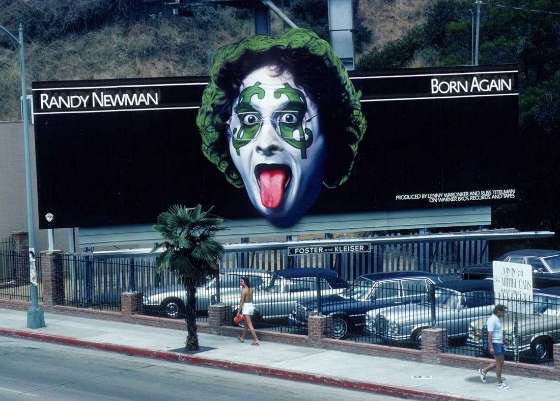
The Rolling Stone critic who reviewed Born Again in 1980 called the album Newman was touring with the night of this tape ‘unremittingly snide,’ suggesting Newman had ‘shrunk to the size of Martin Mull.’ The tape answers that charge. The audience at Campbell Hall on February 29 was not being sneered at, nor were they sneering at anyone else.
Sail Away (1972, Sail Away)
Newman wrote ‘Sail Away’ from the point of view of a slave trader pitching his offer to a prospective captive in Africa. The sweetness of the melody is the tragedy.
Newman has said he didn’t want to simply declare that slavery was awful — that felt too easy. His unreliable narrator doesn’t know he’s the villain. He believes in what he’s selling. That belief is the horror. The New Republic argued that ‘Sail Away’ debunks American exceptionalism with a panache no progressive scholar has equaled. The proof is in the covers: Etta James heard the knife in the song immediately. Bobby Darin sang it straight and missed it entirely. That gap — between the listener who catches it and the listener who doesn’t — is where Newman has always lived.
Louisiana 1927 (1974, Good Old Boys)
In the Great Mississippi Flood of 1927, roughly 700,000 people were left homeless. The federal response was indifferent. The North looked away. Newman wrote about it from the perspective of a Louisiana resident watching Coolidge arrive by train to do nothing — ‘a little fat man with a notepad in his hand.’
In a 2008 interview with the Village Voice, Newman said he wouldn’t have kept playing it except, “It’s the same tune as “Sail Away.”’ One melody. The slave ship and the flood. The promise of America and its abandonment of the same people that promise was made to.
When Hurricane Katrina hit in 2005, ‘Louisiana 1927’ became the unofficial anthem within days. Aaron Neville performed it at an NPR fundraiser that September. The song had been waiting thirty years for the occasion. In June 2026, CBS News included it in its Essential American Songbook — 250 songs nominated by notable Americans to mark the country’s 250th birthday. The same month, Taylor Swift sang ‘You’ve Got a Friend in Me.’
God’s Song (That’s Why I Love Mankind) (1972, Sail Away)
Newman is an atheist who has said he ‘never had faith, but he has respect’ for the idea. He also famously said, “There’s no joy being an atheist.” The God he invents in ‘God’s Song’ is not the one in the Sunday hymnal. Newman’s God is cold, amused, contemptuous — watching Cain kill Abel, ignoring unanswered prayers, professing to love mankind the way a child loves a prized toy.
In interview Newman continues to refuse the stock anti-theist position. He inhabits the indifference from the inside and invites the audience to sit there with him.
The Girls in My Life, Pt. 1 (1979, Born Again)
The Live 1982 recording is the earliest known circulating live performance of the song. The Campbell Hall tape predates it by two years. The unreliable narrator is the Newman’s prototype: someone who can’t see themselves as other do, aren’t clearly rendered with enough interiority for themselves so that others have no choice but to marvel at the blind spots, while looking for their own. The narrator isn’t a monster, and not a saint. He’s just a person – like the listener.
Tenderness That Implicates
Robert Hilburn’s Newman biography carries a jacket blurb from Bruce Springsteen calling Newman “…our great master of American song and storytelling.” Newman’s method works because it doesn’t punish. Elvis Costello once said that Newman’s portraits of grotesques carry “the smallest but essential sliver of sympathy.” That sliver is not mercy granted to the character. It’s the door left open for the listener.
‘Sail Away’ has been sung straight by people who heard the beauty and missed the trap. ‘Rednecks’ has been adopted by the people it was written about. Gentleness, as a satirical strategy, is only as effective as the listener’s willingness to catch it. Newman cannot control that. He writes the song. He trusts the room.
At Campbell Hall on Leap Day 1980, the room caught it. The applause after ‘Rednecks’ was the night’s devastating final turn, the one that points the accusation back at the audience. Tonight the applause the way it does like at the end of a play when people know they’ve heard something true. The tape caught that too.
Newman has said that songwriters are supposed to put themselves in what they do, and that audiences like them best when they do. Taylor Swift perfected the tradition, and she built an empire on it. Newman wrote himself out for fifty years, into slave traders and rednecks and indifferent gods and men who can’t see themselves.
The songs on this tape about the flood, the slave ship, the cold deity, and the man who can’t see himself sat in a box. The culture kept the toy song. It handed it to the bride.
The tape is what got left out. Press play.
Recovered Set List — Campbell Hall, UCSB, February 29, 1980
1. They Just Got Married (1979, Born Again)
2. Yellow Man (1970, 12 Songs)
3. Marie (1974, Good Old Boys)
4. Birmingham (1974, Good Old Boys)
5. You Can Leave Your Hat On (1972, Sail Away)
6. Ghosts (1979, Born Again)
7. Short People (1977, Little Criminals)
8. Sigmund Freud’s Impersonation of Albert Einstein in America (1979, Born Again)
9. Louisiana 1927 (1974, Good Old Boys)
10. The Girls in My Life, Pt. 1 (1979, Born Again)
11. The Story of a Rock and Roll Band (1979, Born Again)
12. Simon Smith and the Amazing Dancing Bear (1972, Sail Away)
13. Sail Away (1972, Sail Away)
14. God’s Song (That’s Why I Love Mankind) (1972, Sail Away)
15. In Germany Before the War (1977, Little Criminals)
16. Political Science (1972, Sail Away)
17. A Wedding in Cherokee County (1974, Good Old Boys)
18. Linda (1968, Randy Newman)
19. Rider in the Rain (1977, Little Criminals)
20. Guilty (1974, Good Old Boys)
21. Rednecks (1974, Good Old Boys)
Epilogue
The set list is listed as “recovered” because the show spanned more than one tape. For some reason several songs are on the Weather Report encore tape. I don’t have a clue why, and I expect to continue to find odds and ends on tapes as I work my way through the archive of 200 tapes. Last week while trying to piece together a Bonnie Raitt “Stop Diablo Canyon” benefit show I ran across a two-song solo performance by Graham Nash, including “Just a Song” which was just beautiful.
For more from the Randy Newman concert on Leap Day 1980, visit:
Get Aggrovox by email
Live tapes, unreleased concerts and the stories behind them. Free, in your inbox.
Free on Substack · Aggrovox