Santana Live & Unreleased – Turn This One Waaay Up Before Reading
Astonished by a concert recording I made more than 46 years later

Santana Live & Unreleased – Turn This One Waaay Up Before Reading · Aggrovox
Press play on AggrovoxThe original post on Substack, with the full audio playerPRESS PLAY BEFORE READING
Santana - Europa, Savor, Jingo; Santa Barbara County Bowl, September 12, 1980, TRT 23:14, stereo, audience mic
Turn it up
Astonished. Listening to Europa, Savor, and Jingo while mixing and processing the raw digitized file. So, I turn up the volume on the monitors. More astonishment and twenty-three minutes of joy with a smile from ear to ear. Percussion-driven music is almost always joyful, with a lurking side of ‘wake up or I’ll slap you in the head’ ever-present. It’s impossible not to move to good percussion - that’s probably the point.
I don’t know how many times I’ve seen Santana perform. The first time is on campus at UCSB’s Rob Gym in January ’77. Rob Gym is a sweaty, booming cavern of a gymnasium, more like a large high school gym today. In January it’s freezing, and in summer it’s too hot to do anything but sweat. The show opens with Journey – absolutely no recollection at all and I would remember Don’t Stop Believin’, but that hit comes out years later. On this night Carlos is the headliner. It’s at least his fifth appearance in Santa Barbara.
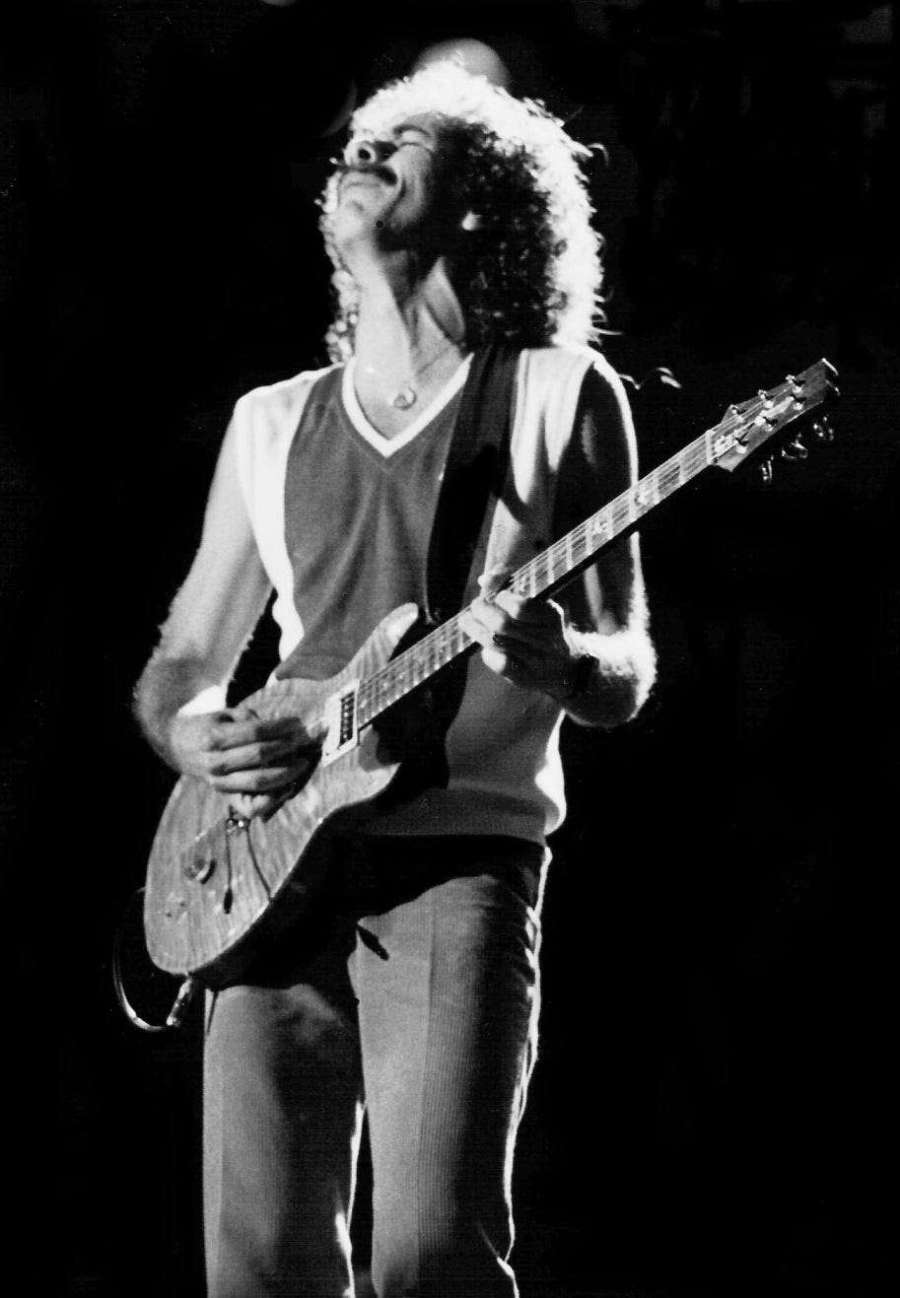
Friday night in 1980 at the Santa Barbara County Bowl all 4,646 fans at the sold-out show are moving. It’s audible on the tape when someone dances in front of the stereo mics, and listening now with headphones it’s a little eerie - like time travel.
Astonished by a recording that 46 years later brings the listener to Section K, just right of the soundboard, and above the open lawn area which is eye-level with the performers onstage. The crowd of more than a thousand on the lawn is really working the rhythm. In the distance, behind and to the right of the wings of the stage twinkling greenish halide lights on the oil rigs in the Santa Barbara Channel herald Jim Morrison’s ‘crystal ships’ making an appearance for the occasion.
The Tape
What’s to like? Everything!
The three-song triptych curated here – Europa, Savor, and Jingo – fades in on the tape with voices heard in a chant. Percussion soon joins, and the recording levels slowly rise as I adjust the gain. Sadly, the first few moments of the chant aren’t on the tape, but there are good reasons.
Quality cassette tapes and batteries are surprisingly expensive in 1980 – at least for a poor student. The ticket stub shows $9.75 for the show and then we add a 90-minute Maxell II at around $2, and two “D” batteries. These aren’t rechargeable and weigh a ton and cost another $2 per show! Added to the cost there’s the show logistics: the contracted length of an average show is around 100 minutes. That means that a judicious use of starting and stopping the tape between songs makes recording the entire performance just about possible on a ninety-minute tape – without all that between-song chatter (which now turns out of course to be invaluable).
Europa, Savor, and Jingo fall smack in the middle of the show. There's a brief dropout in the opening chant, a battery change in the middle of Savor, and a tape flip at the end of it – all left in the exported file for authenticity. For additional ‘color’ the recording levels rise and fall as I fumble with the gain, and the mic ‘hears’ fellow concertgoers as they create ‘sonic shadows’ as they pass in front of the stereo mic.
“Europa” opens with three minutes of voice and percussion: rising and falling over congas and timbales. The chant is likely Lucumí, the Cuban ritual language descended from Yoruba of the Afro-Cuban tradition that Armando Peraza and Orestes Vilató bring from Havana and Camagüey. A setlist from the band’s German TV broadcast from Dortmund, three months earlier, gives the piece a one-word title: “Chant.”
My 1980 recording features a candidate for the world’s longest feedback sustain – in Europa - a one-minute and two-second-long sustaining “G” with a “D” note two octaves higher as the overtone. Carlos uses the sustain to pass the spotlight to a mini bass and organ solo, and Europa gives way to the driving, organ- and percussion-heavy Savor. An unexplained dropout happens in the middle of the epic percussion solo in the song; the drums alone are worth the price of admission. It’s a guess, but likely Peraza plays the bongo lead, Raul Rekow plays the fat, slapping congas (among other instruments), and Orestes Vilató plays the timbales and small cymbals. All of it held down by Graham Lear on the traditional drum kit.
edsullivan.com/artists/santana
“Jingo” (also written “Jin-go-lo-ba”) starts the B-side of the cassette, a bar or two into the song; precious seconds lost to the tape flip. It’s the maker’s mark, the imperfection that proves this is not, thankfully, AI.
The chanted, call-and-response vocal in Jingo is written by Babatunde Olatunji, the Nigerian drummer whose album Drums of Passion brings Yoruba drumming to American record buyers. Santana makes Jingo their first single in 1969, and here, as on that first album and at Woodstock, it follows Savor. The 23 minutes end the way they began: voices and drums, the Nigerian original answering the Afro-Cuban chant that opens Europa.
The Percussionists
Two Cubans and a San Francisco kid, ages about 56, 36 and 26.
Armando Peraza is a self-taught Havana street orphan who wins an audition in Cuba. In his career he plays with Machito, Charlie Parker and George Shearing, and is is on Mongo, Mongo Santamaría's 1959 album that introduces “Afro Blue.” Santamaría, the Havana-born conga player, becomes Peraza’s longtime friend. In 1948, Santamaría travels to Mexico City to tour with Armando Peraza’s dance troupe. Two years later, Peraza and Santamaría move to New York City, where they bring Afro-Cuban rhythms to the city’s jazz and pop music scene.
Orestes Vilató debuts and spends eight years with Ray Barretto, before joining the Fania All-Stars and 1980 is his first year with Santana. He’s quoted as saying about his approach to being in the band: “If I play with Santana, you gotta play different.”
Raul Rekow is San Francisco-born and a French horn player in school. Seeing Marcus Malone with the early Santana Blues Band in the Bay Area makes him determined to be a conga player. He studies under Peraza and Vilató, so on this tape the student plays between his two teachers.
The Rig
Astonishment. A cassette recorder about the size of a cigar box, the original Sony TC-D5. In early 1978 I purchase one of the first in California from the Sony broadcast dealer in Burbank – the same place that outfits LA-based TV news and documentary film crews. I also buy Sony’s ECM-990 stereo microphone, designed to be paired with the recorder.
The TC-D5 runs on batteries or a 12v external AC adaptor (the size of a brick, lol). The deck has a servo-controlled motor that keeps the tape speed steady while it bounces around in a bag or on a lap. On paper it records from 20 to 18,000 hertz, nearly the whole range of human hearing. The ECM-990 is an odd-looking thing - held in the wrong orientation it resembles a certain human male anatomy – two cardioid capsules stacked on the side of a traditional mic tube. The ECM is why the drums sit a little left in the mix and the crowd ‘surrounds’ the listener in aural 3D.
Together the deck and mic cost just under $1,000 in 1978 – about $5,000 in today’s money. In both eras you can just about buy a high-mileage, small used car for the same price. It is beyond extravagant for a student, and my guess is that it represents summer money earned, and work-study money from shelving books – and maybe some Christmas and birthday money thrown in.
Listening and Remembering
Streaming here isn’t the raw cassette; it’s the original tape playing back on a rebuilt 1987 Nakamichi CR-3A, digitized in stereo 24-bit through a Scarlett 6i6 analog-to-digital I/O. The release file features a light touch of EQ and compression (I’m still learning this part) which dramatically improves the listening experience. The deck, sadly, no longer works, but 99.9% of the tapes in the archive were made on it.
Santana played Santa Barbara at least five times before Sept. 1980 – three times in 1969, then Rob Gym in 1974 and 1977. In 2026 the Mayor of Santa Barbara presents Santana with a proclamation, thanking him for playing the city 40 times over 50 years.
By 1980 these songs run longer, the percussion section is three deep, and somebody next to the soundboard has a tape deck running. So, turn it up again, and follow the drums back to where they came from.
Santanamigos (santanamigos.com) is the fan-built archive that helped with research into the historical context that informs the article. The site’s founder and webmaster, and self-described Santanamigo since 1976, is Karim Brichi, who works from the Alpes-Maritimes region of France. The year-by-year record of tour dates and accompanying ephemera is inspiring, and it’s an enormous archive that I used to better understand Santana’s touring schedule on either side of the show I recorded. I even learned that I just missed Santana in France the summer I worked at the Nice Jazz Festival – the band played the Roman arena in Fréjus, about 40 miles down the coast, on July 11 and 12, 1980.
Dick Dixon is Santanamigos’ “Poster Master,” and he created another amazing feature on the site: a huge collection of concert posters for hundreds of Santana shows through the years. The poster archive is invaluable, offering the viewer deeper visibility into each show including the opening acts, the details of the venue, and the promoter.
I am indebted to both Karim and Dick for their work creating and administering these important archives!
All I Ever Wanted
All I Ever Wanted
Incident at Neshabur
Incident at Neshabur
Tales of Kilimanjaro
Tales of Kilimanjaro
Black Magic Woman / Gypsy Queen
Black Magic Woman / Gypsy Queen
Lightning in the Sky
Lightning in the Sky
Chant
Chant
Europa
Europa
Savor
Savor
Jin-go-lo-ba
Jin-go-lo-ba
Well All Right
Well All Right
Runnin’
Runnin’
Soul Sacrifice / Concierto de Aranjuez
Soul Sacrifice / Concierto de Aranjuez
Open Invitation
Open Invitation
She’s Not There
She’s Not There
Evil Ways
Evil Ways
Get Aggrovox by email
Live tapes, unreleased concerts and the stories behind them. Free, in your inbox.
Free on Substack · Aggrovox