Press PLAY before reading - Weather Report: The Birdland Medley
The band's drummer, Peter Erskine recalls the Arlington Theater performance, February 28, 1980

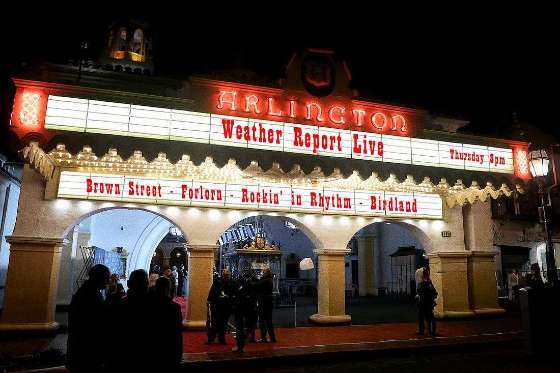
Press PLAY before reading - Weather Report: The Birdland Medley · Aggrovox
Press play on AggrovoxThe original post on Substack, with the full audio playerTRT 26 minutes: Brown Street / Forlorn / Rockin’ in Rhythm / Birdland — Arlington Theater, Feb. 28, 1980
I started digitizing my audio archive at the end of 2025 – I couldn’t look at the boxes of 40- and 50-year-old tapes in the garage any longer, knowing they would eventually turn into dust. These performances deserve more. I feel like they demand more.
As I was getting familiar with Substack in late ‘25, I created the Aggrovox publication and included an image of the early stages of an Excel spreadsheet. I had indexed about half the tapes by then, and the list was 60 rows and growing. I posted to my 1k followers on Bluesky as well, hoping to grow an Aggrovox audience. (It’s slow going after six months, but I’m learning with every article).
Glen Dunlap saw my post on Bluesky and left a comment. His uncle, Dick, a lifelong jazz musician was starting hospice and Glen believed he would especially like hearing the Weather Report show.
In nearly 50 years of dragging these tapes around in boxes, nobody had ever asked to hear anything specific. Glen is the first.
Glen’s uncle lives in my hometown. Richard “Dick” Dunlap (December 7, 1939 – June 2, 2026) is a keyboard player, composer, visual artist, intermedia artist, and long a significant figure in Santa Barbara’s creative community. Born in Seattle in 1939, he received an MFA in painting from the University of Washington and taught in the Art Studio Department at UCSB from 1969 to 1977 — the same years that Weather Report was forming and releasing its first records. Dick’s jazz career starts in the 1950’s and he has been performing ever since. He recorded an innovative art installation featuring solo piano improvisation at the Santa Barbara Museum of Art in 1981, a year after the Arlington show I recorded. In 2024 he released the recordings of the Art Museum event as what Glen describes as part of the “Dick Dunlap Archival Liberation” project. Dick’s most recent album, Confirmation, was released in 2026, curated by uncle and nephew together.
When Glen reached out, Dick was at home in hospice care.
When I heard from Glen, I immediately started digitizing the Arlington tapes, adding some basic mixing and EQ, and finally I uploaded the full show to YouTube. I don’t post full shows, and I never post without writing about the performance. This seemed like the right time to make exceptions.
Glen wrote back four days later: “We had a nice listening session, thank you…it was fantastic!”
I like to think of their reaction to the 26-minute medley near the end of the show: Brown Street, Forlorn, Rockin’ in Rhythm, and Birdland. The four songs run continuously, one piece flowing into the next, the way Weather Report played it every night on the 1980 Night Passage tour. The Milan show from late 1980 includes the exact same sequence in the same order. So does every other documented setlist from that year.
After listening to the show many times while I was digitizing and mixing, Brown Street stood out to me – it’s so … happy. I originally reached out to Weather Report’s drummer, Peter Erskine to ask his recollections of the song.
Brown Street runs about twelve minutes during the Arlington performance. The studio version on the band’s album 8:30 runs about four minutes. The eight-minute difference tells the listener everything they need to know about the difference between Weather Report recorded for an album, and the band playing live. It’s such a marked change that it sometimes takes a careful listening to match the live version to the album version. (Ask me how I know…)
In an email exchange with Peter, I tell him I plan to write about Brown Street because it’s so approachable, and so uplifting. He graciously replies and tells me that he agrees, “It is a friendly and uplifting sojourn of a piece.”
The origin story of Brown Street is worth telling carefully, because it may be more nuanced than what the album credits suggest.
The album reads: “Brown Street, composed by Joe Zawinul and Wayne Shorter.”
The full story, according to Erskine who was in the room the day the song was written, is a bit more complicated.
As Erskine explains, it’s 1979 and Joe Zawinul is living in Pasadena. He has a music room in his home and a Nakamichi cassette deck that records essentially everything that happens in that room. Wayne Shorter is there. Erskine is there. Jaco Pastorius is not there, but he and Erskine add bass and additional percussion later.
Erskine describes to me the inspiration he used to start the collaboration that day. “I began the piece by playing a variation of a beat I had heard former Weather Report percussionist Dom Um Romao play on one of his albums,” he told me, “And the tune spun itself from that beginning.”
Zawinul and Shorter collaborated on the melodies, and the song took shape. Also in the room: Erich Zawinul, Joe’s young son. “He was a small child at the time,” Erskine says. “He was in the room, playing with some shakers at some point during the initial playing of the piece.” Erich is credited on the album.
The home cassette recording was later transferred to 24-track two-inch reel-to-reel tape. Shorter went back and reproduced much of what he’d improvised to get a better saxophone track. Jaco and Erskine added percussion after the fact. The Nakamichi home recording becomes a track on the band’s Grammy-winning live album, 8:30.
Erskine describes his feeling that the rhythm that gave structure to the song in that living room in Pasadena was a foundational element to the tune, and he asked Zawinul if he shouldn’t receive a co-writing credit along with Shorter.
“Sing me one melody you wrote on that piece!” Erskine reports that Zawinul responded.
Today Erskine is philosophical about the experience. “He was not always the most generous of men.”
I asked him why the song is called Brown Street. “To be honest, I don’t remember why he called it that,’ Erskine said. ‘I seem to recall that it had to do with brown-skinned people and they lived on this make-believe avenue called Brown Street. Not sure …”
After Brown Street the medley moves through Forlorn — sparse, atmospheric, almost unsettling, a piece that The Annotated Discography suggests echoes the emotional weight Zawinul associated with his childhood in Austria — and into Rockin’ in Rhythm, a 1930 Duke Ellington composition co-written with Barney Bigard and Irving Mills. It’s the only cover in the Arlington setlist. The temperature shift from Forlorn’s slow desolation into the swinging Ellington is one of the more dramatic moments in the show.
Then Birdland.
Zawinul wrote Birdland, named for the famous Broadway jazz club that hosted Charlie Parker, Dizzy Gillespie, and Miles Davis in the bebop years. It appeared on 1977’s Heavy Weather, and the opening synthesizer riff became one of the most recognizable instrumental passages in American music of the last fifty years. When the band launches into it at the Arlington — after Forlorn and Rockin’ in Rhythm have set it up — the room knows instantly. You can hear it on the tape.
A note on the tape itself: somewhere in the first verse of Birdland I had to change cassettes. I did it quickly. The gap is brief. You’ll hear it.
Dick Dunlap heard it too. The local keyboard player who has been performing jazz since the 1950s, who was teaching at UCSB the year Weather Report first came to Santa Barbara, who spent a lifetime making music in this city — he heard the whole thing, tape change and all, from his house on Anacapa Street.
Glen said it was fantastic.
That’s enough reason for me to keep digitizing the tapes.
—
Weather Report released Night Passage in November 1980, nine months after the Arlington show. Most of the songs in this medley — including several you’ve just heard — were road-tested on the Night Passage tour before the album existed. The Arlington audience heard them first.
The percussion solo that follows this medley on the tape is the subject of the companion article, Weather Report: The Percussion Solo, also on Aggrovox.
Peter Erskine’s autobiography, No Beethoven: An Autobiography and Chronicle of Weather Report, published in 2013 by Alfred Music, chronicles his years with Weather Report and beyond. Neil Peart called it ‘among the best musical autobiographies I have read.’ In 2015, Sony Legacy released The Legendary Live Tapes: 1978–1981...”
Dick Dunlap’s music is available on Bandcamp, Spotify, Apple Music, and YouTube at richarddickdunlap.bandcamp.com. Buy it here: https://dickdunlap.com/shop/.
Glen Dunlap’s photography is at glendunlap.com.
Get Aggrovox by email
Live tapes, unreleased concerts and the stories behind them. Free, in your inbox.
Free on Substack · Aggrovox