Randy Newman: Chemicals, the Flood, and the Big One
America’s Greatest Living Songwriter at UCSB Campbell Hall, Feb. 29, 1980

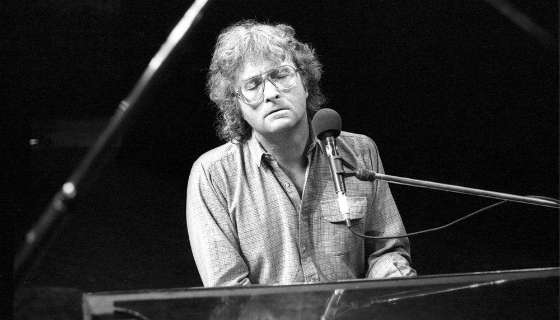
Randy Newman: Chemicals, the Flood, and the Big One · Aggrovox
Press play on AggrovoxThe original post on Substack, with the full audio playerSanta Barbara is recovering from ten-days of biblical flooding. Six back-to-back Pacific storms bring nearly a full year’s rainfall to Southern California in ten days. Over twelve inches fall along the coast, and twenty inches or more saturate the mountains. The 1980 Sierra ski season is one for the record books.
Inside Campbell Hall, everything and everyone is soggy. I’m doing my best to keep the Sony D5 cassette recorder running, and the matching Sony stereo microphone dry. On playback today, like modern magic the tape captures everything faithfully – the fidelity after nearly half a century is remarkable. Newman’s piano is bright through the PA, the acoustic brilliance of Campbell Hall’s proscenium stage projects every nuance of his wonderfully unique voice. Even the audience sounds good on the tape.
The college audience receives Newman warmly. His unique songwriting demands critical thinking, perfect for these inquiring minds. His mega-literate stories span America’s complicated history, especially with race, and that night Newman’s words resonate with the audience’s sense that a remarkable set of events is unfolding.
The day before I watch in amazement from my apartment balcony on Del Playa Ave. in Isla Vista while a piece of cliff the size of a semi-truck falls into the ocean with a ‘whump’. My roommates and I find seaweed and bits of battered sea life stuck to the sliding glass doors on the second floor from a storm that lashed the building all night.
Leap Day feels in retrospect like the perfect night for a Randy Newman concert. His artistic voice is unique, as is his one-of-a-kind delivery while he’s singing about topics that no one else wants to touch. When the NYT “30 Greatest Living American Songwriters” article excludes Newman, the music world’s shit hits the fan.
Variety’s headline screams, “Where in the Actual Hell is Randy Newman…?” So respected among his fellow songwriters is Newman that he is reportedly one of the top two vote getters, and yet the Times’ critics cut him out.
The music writer Sean Fennessey, pays Newman a compliment in his terrific 2017 article, “Randy Newman’s American Monsters” when he writes, “Newman is one of the most covered artists of recent times — Norah Jones, Joe Cocker, Etta James, Three Dog Night, Nina Simone, Bette Midler, and Ringo Starr have all taken a crack — but his songs have rarely worked properly in the voices of others.”
Tonight is pure Newman: just his voice, solo at the piano. Until I listen back to the recording, I’d forgotten how completely he charms the audience. Newman’s banter between songs creates cinematic-level intimacy for nearly a thousand strangers on a rainy night in a crowded, darkened theater.
Before Newman’s more biting satirical political content hits, he has a problem to share with the audience. “My house is flooding right now, man” he drawls. “Not sure what I’m gonna do.”
Then he invites us further into his state of mind. “My house got flooded so I’ve been depressed” he tells us at one point, and then, “I gotta take a lot of pills now and I just realized I haven’t taken any today.” Two sentences offering rare access to the inner monologue of one of the most astute cultural humorists in a generation. Famed composer John Williams reportedly said on a Connecticut Public Radio interview that he thought of Newman as a sort of ‘musical Will Rogers, or Mark Twain’.
Newman at the piano on a rainy night in 1980 is a slightly rumpled, self-deprecating, (maybe) chemically dependent, and depressed man with a flooded house and a gift for melody that reaches back generations to his family’s deep Hollywood music tradition. His uncles Alfred and Lionel Newman scored more than 200 films, and the extended family gathered routinely and made music at the uncles’ large house on LA’s West side while Newman was growing up. It may be that same house, Newman’s ancestral center that is flooding that night.
“What Color Were They?”
Using his narrative voice to encourage change is table stakes for Newman, and controversial for others. When the song’s narrator is a racist Southerner after the Civil War, Newman isn’t defending or promoting the character’s point of view, he’s decoding him and inviting us along.
Randy Newman in a production of his musical “Faust,” covered by the Hollywood Reporter
There is a moment in the set during Newman’s song “Ghosts” that deserves its own accounting. I unfortunately missed the first two lines of the song - a tape change done too slow perhaps. In the darkened hall a male voice cuts through during the song’s second verse. There’s already some tension in the room. Not anger. A young man’s tenuously raised voice; he has done a calculation and wants the room to know it but doesn’t quite have the force of his own conviction. “What color were they?” he yells into the dark after the song’s narrator uses a colloquial term. The young man’s tone suggests that he hopes for agreement from the audience – but he doesn’t get it.
And then nothing. Newman doesn’t acknowledge it. The audience doesn’t pick it up. The question hangs for a second and then the room swallows it whole, the way rooms swallow things that don’t have an easy solution.
Hearing the raised voice my reflexive response is agreement, ‘Yeah, you can’t say that’. Then I realize the reflexive response misses the chance Newman gives us to inhabit his characters so we might understand them – and he’s invented a seemingly Dickensian volume of odd humans, and not a few animals to help us. Missing the chance to understand Newman’s menagerie means missing the point of his writing and his art. We don’t ‘agree’ with the narrator - we understand him, and through understanding we move the conversation and society beyond his limited perspective.
Drop the Big One
By the time he performs “Political Science” the set has already moved through a significant amount of new material. The audience has had four months to absorb the songs on the new album, “Born Again.”
“Political Science” is on Newman’s album, “Sail Away,” released in 1972. It’s a Vietnam era song, eight years old now. In 1980 lives hang in the balance at the height of the Iran Hostage Crisis and an aging actor who many are convinced is senile sits in the White House. The song feels very relevant.
The narrator surveys a hostile and ungrateful world and arrives at a solution of bored simplicity: bomb it. All of it. Except Australia. It’s a satire of American exceptionalism and the song challenges us to push back. It’s the voice of the “average American,” the guy at the end of the bar who’s had enough, whose patience with complexity has run out, who just wants it dealt with.
The crowd laughs and cheers throughout. “Conservative crowd,” he says, “I wasn’t expecting that!” It’s practiced patter from Newman the studied performer.
He knows what he has engineered; the audience reaction to the line about dropping the big one isn’t 100% the ironic laugh of people in on the joke. There’s something else in the reaction. Something that sounds if you listen to the tape, uncomfortably like support for the idea of nuclear obliteration. Between the weather, Iran, and Reagan who sent National Guard troops to the same campus nine years earlier, the crowd tonight has an uncomfortable amount in common with the guy at the end of the bar.
Most crowds likely play right into Newman’s narrative hands night after night. Could it be reminiscent of the Marx Brothers working out scenes on stage for their movie “Night at the Opera” in a Vaudeville house in the 1930’s, charting and measuring every laugh night after night?
Audience participation makes Newman dangerous. His songs are controversial, but not in the obvious way. It’s not the content that make his art dangerous, which is outrageous on its surface, it’s the structure that turns the audience’s own exhaustion into the punchline. The narrator’s perspective is outrageous. The audience knows the narrator is out of his mind and yet there’s relief in their laughter when he arrives at his horrific conclusion. Newman expects self-reflection when we agree with his narrators. We are supposed to learn something about ourselves that makes going along the next time a little less reflexive.
“It’s My Favorite Thing I’ve Ever Written”
After “Political Science” comes “A Wedding in Cherokee County.” Newman introduces the song by saying he’s taken it from an old Albanian folk song. Before starting the chorus, he readies us, “This is the Albanian part,” and sings “I’m not afraid of the gray wolf that stalks through our forests at dawn.” Howls from the crowd prompt him to tell us, “This is the favorite thing I’ve ever written! I’m going to play that part again.” He plays the chorus again and the crowd erupts.
Randy Newman, “Good Old Boys” 1974 Reprise Records, starts one of his most controversial songs, Rednecks
“A Wedding In Cherokee County” is not a well-known song. It does have a few truly great lines, but there are so many great lines in Newman’s work it’s impossible to keep track. He’s a one-man meme machine. What the song does have is Newman’s quintessential self-deprecation. Newman sits at the piano and plays the thing he loves most, which turns out to be hysterically funny.
“Everything I’ve written is funny,” Newman has been quoted as saying in interviews. He sounds more than a little proud when he tells an interviewer, “More of my songs are intended to be funny than almost anyone else, outside of ‘Weird Al’ Yankovic.”
Rider in the Rain
The set ends with “Rider in the Rain” — it’s been a standard for Newman live performances since he debuted it on national TV on Saturday Night Live in 1978. “Guilty” is still to come as an encore, but ‘Rider’ is the emotional conclusion, and Newman engineers it perfectly. It’s more like a one-man Broadway show than a concert. *
At first glance “Rider in the Rain” doesn’t seem like it should be the song that brings down the house, but it does. The crowd has heard it maybe a handful of times at most. It’s not “Short People.” It’s not “You Can Leave Your Hat On” (he plays those hits during the show). “Rider in the Rain” is about a man striking out to make his fortune – the American dream brought to life – leaving behind a wife, and a mother – a lone man with a horse … and some rain. It’s really high tongue-in-cheek satire of the great American western.
Best of all the song contains a natural bridge that invites the audience to sing along. What happens next is a demonstration of what Randy Newman can do with a room. The Sony D5 captures the room rising — the individual voices becoming a collective voice, finding the melody, and the melody filling Campbell Hall. Newman is more than pleased.
This is what it costs to earn a singalong. You’ve got to take the audience somewhere first. You’ve got to make them laugh at themselves, invite them to laugh along with you, ask them questions they don’t want to answer, and then tell them the thing you love most. Only then can you invite them to sing in a university lecture hall with a flooded house and forgotten medication and a tape recorder running eight rows back. The chemicals, whatever they were, do not appear to have been essential to the process.
Epilogue
Newman recently collaborated with Jon Batiste on the song and short film, “Lonely Avenue.” Seated at the piano in the film the artists’ generous spirits shine through the hazy, filmic scene. As the song’s final note sustains on the piano, Newman gently takes Batiste’s hand and kisses it – a gesture that feels like grace, like he’s saying, “Thanks.” For the beauty of the music, for the shared moment, and for giving voice to the words that Doc Pomus wrote, and Ray Charles made famous in 1956. I’ll always remember Newman’s voice hanging in the air at Campbell Hall granting me a little of that same grace.
Lonely Avenue – Jon Batiste + Randy Newman
The February 29, 1980 Randy Newman concert at Campbell Hall recording was made on a Sony TC D5 cassette recorder with matched Sony stereo microphone from row 8, center, Campbell Hall, University of California Santa Barbara. The tape has never been commercially released and is believed to be the only known recording of this performance.
*It’s unfortunate that a one-man Broadway show for Newman never happened. The sheer volume of his catalogue and the variety of the characters in his songs would seem a natural for creative interpretation.
Get Aggrovox by email
Live tapes, unreleased concerts and the stories behind them. Free, in your inbox.
Free on Substack · Aggrovox